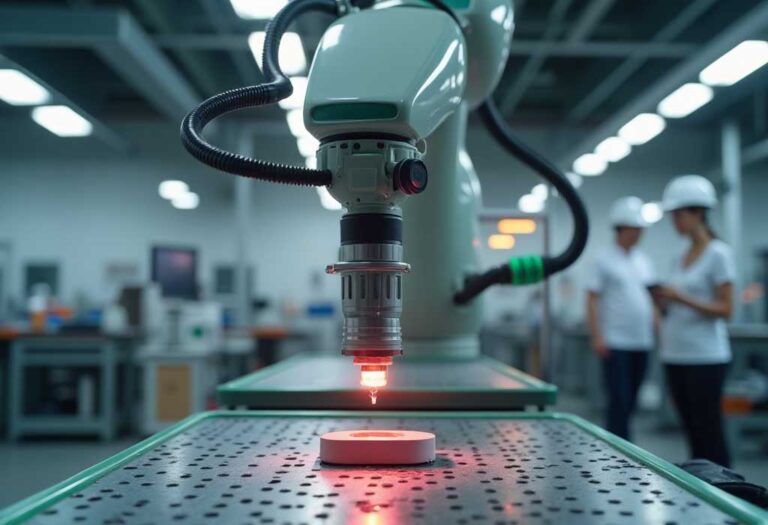
Die change systems are important tools for improving the efficiency and competitiveness of modern production facilities. The progression from SMED to NOTED also reflects advances in production technology. Businesses can achieve significant benefits by selecting and correctly implementing the system best suited to their circumstances.
SMED (Single-Minute Exchange of Die)
SMED is a revolutionary approach to production lines. Developed by Shigeo Shingo, it aims to reduce die change times to single-digit minutes. Its core principle is to separate and optimise internal and external setup operations.
SMED is implemented in four main stages: analyse the current situation, identify internal and external setup operations, convert feasible internal operations into external ones, and improve all processes. Planning and standardising parallel operations is one of its key techniques.
SMED offers wide-ranging benefits: greater production flexibility, lower inventory levels, optimised capacity utilisation and reduced labour costs. It also improves quality control processes and employee motivation.
OTED (One-Touch Exchange of Die)
A step beyond SMED, OTED aims to perform die changes with a “single touch”. This approach relies more heavily on automation and minimises human intervention.
OTED uses advanced technologies such as hydraulic and pneumatic systems, sensors and automatic locking mechanisms. Although installation requires a high initial investment, it provides substantial long-term savings.
Its main advantage is reducing die change times to seconds. It also minimises operator errors, improves workplace safety and provides flexibility in production planning.
NOTED (No-Touch Exchange of Die)
NOTED represents the most advanced level of die change systems. Die changes are fully automatic, with no human intervention. This approach is fully compatible with Industry 4.0 and smart factory concepts.
Implementation requires the integration of advanced automation, robotics and AI-assisted control mechanisms. NOTED systems are generally preferred by technology-intensive businesses with high production volumes.
The main benefits of NOTED include zero operator intervention, maximum workplace safety, consistent and repeatable die changes, fully automated production flow and minimal downtime.
Comparative Analysis of the Systems
These three systems can be viewed as successive developments. SMED establishes the basic principles, OTED combines them with automation, and NOTED achieves full automation.
Investment costs rise as you move from SMED towards NOTED. Operating costs and die change times, however, move in the opposite direction.
Businesses should choose a system based on their production structure, technological infrastructure and financial resources. What matters is that the selected system matches the business's needs and objectives.